
Early Specialisation and Excessive Training Load
Part 2 of 4
In Part 1, I talked about the long-standing call for long-term athlete development.
In this article I want to tackle one of the biggest reasons we’re seeing so many serious injuries in high-level sport: early specialisation, and the excessive training load that comes with it.
Growing bodies become what we train them to do
The problem with doing the same thing over and over again while bones are still growing is that it changes the way the body grows. It isn’t just the muscles that adapt. It’s the infrastructure underneath: joints, bone shape and the movement patterns the brain defaults to. That can cause long-term damage that often doesn’t show up until years later.
Have you seen trees that are permanently bent in the direction of the wind? Even when it’s a calm day, the trunks and branches look like they are hanging on for dear life. That’s because they have been growing under the conditions of strong winds coming from the same direction all of the time. Since they haven’t grown straight and tall, they will fail to live and thrive as well as they should. The trees under repetitive pressures didn’t get a chance to develop as a tree should.
It’s the same reason we say a child must crawl before they walk. Each stage and milestone of a child’s development lays down the movement and loading that the next stage relies on. Skip stages, or narrow them down to one repetitive pattern, and the body builds itself around the gap. The hips, backs and shoulders pay for it later. For example, children that bottom scoot rather than crawl are bound to have a strong disconnection between the left and right lobes of their brain and from the right and left sides of their bodies. This can lead to low muscle tone, lack of coordination, learning difficulties etc.
Then the “High Performance Program” makes it worse
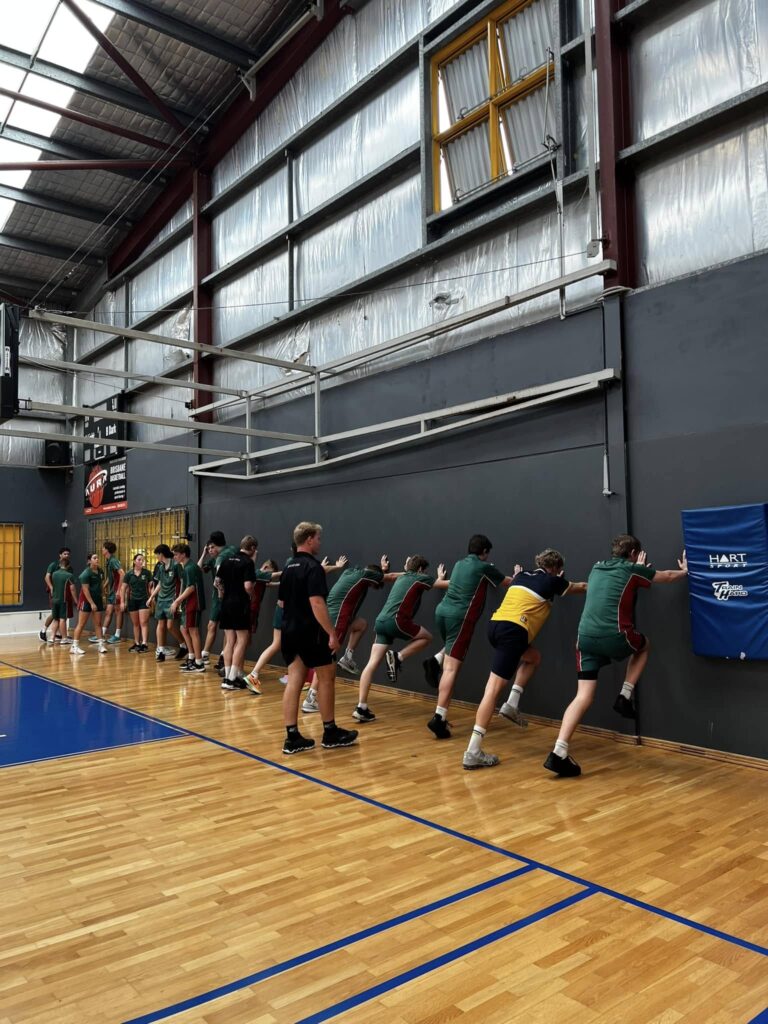
Here’s where it gets even worse. If a child becomes very good at their sport, very early in life, they get put into a High Performance Program. And what does that usually mean? More training on those same specific movements. More volume, more intensity and more repetition of the exact pattern that is already overloading a growing body.
Invariably, that makes matters worse. The talented kid who should be the most protected ends up the most exposed.
The golf example
Golf is a great example. A golf athlete doing golf-specific movements in the gym to increase club head speed is doing the exact WRONG thing.
Golf is a one-sided rotational sport. A young golfer is already rotating thousands of times a week in the same direction. Loading even more of that pattern in the gym just deepens the imbalance.
Golf-specific athlete training should basically be the exact opposite of golf. Rotate the other way. Train the non-dominant side. Build hip and trunk control. Move in the directions golf doesn’t. Balance the body out and you set the athlete up for long-term success and health, and the club head speed has a much better foundation to grow from.
The same thinking applies across sports, from the fast bowler in cricket to the swimmer’s shoulders to the tennis player’s serving arm.
What parents can do
- Let your child play multiple sports through childhood and the early teens
- Add up the total load: school sport, club, rep, PE and private sessions all count
- Ask whether their training is balancing their sport or just repeating it
- Treat early success as a reason to protect your child, not to pile on more
The ‘Bigger Picture’
Being good early is a gift. It is not a reason to train harder, earlier. In my experience, the most specialised kid at 12 is rarely the one still standing, and still improving, at 22.
The goal is not the best 13-year-old in the state. The goal is a healthy, durable athlete who still loves their sport when it really counts.
Written by,
Stewart Briggs, BHMS, M.Ed., C.S.C.S., RSCC*E
Managing Director of Acceleration Australia