

The 10-0-5 Agility Test: A Simple Baseline That Protects Footballers All Season
Football is a game of turns. Cut, plant, change direction and go again. And this happens hundreds of times a match, off both feet. So it makes sense to measure how well a player actually changes direction, and to know early whether one side is doing more of the work than the other.
That’s where the 10-0-5 agility test comes in. It is one of the assessments we run with Vuemotion, the Australian AI movement system. We’ve used Vuemotion’s AI system at Acceleration Australia for two years now, going into our third.
What the 10-0-5 actually tells us
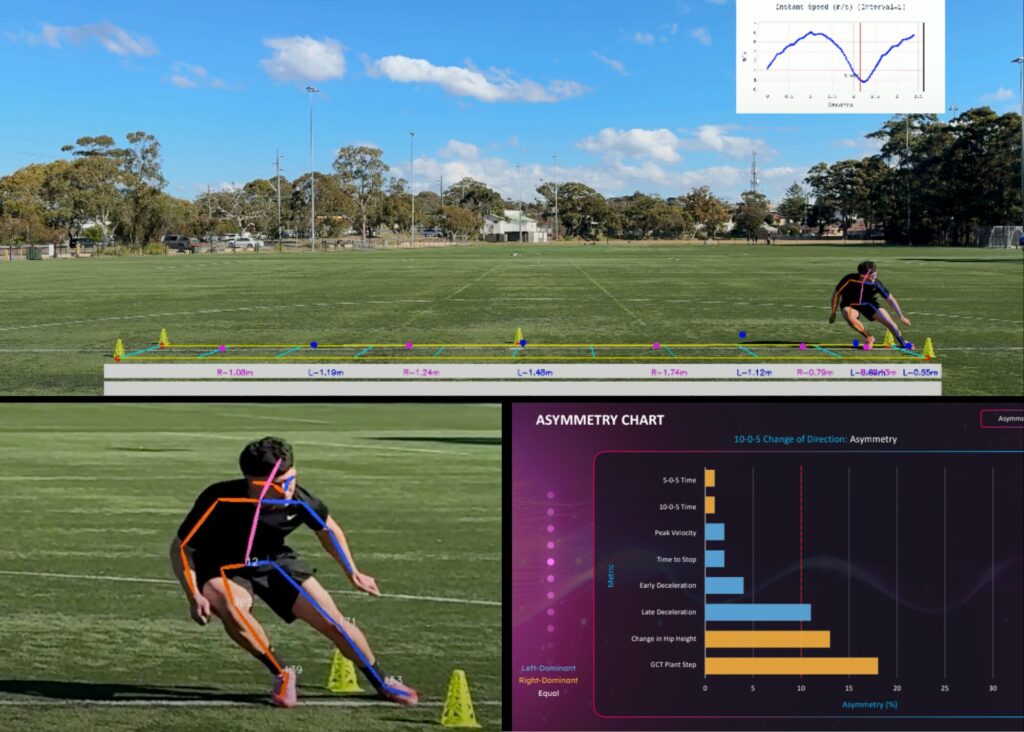
The player accelerates out, decelerates, plants and turns, then sprints back. It looks simple, but it reveals a lot: how quickly an athlete can slow down, change direction and re-accelerate. The change-of-direction deficit is what separates a genuinely agile player from one who is merely fast in a straight line.1,2
Left side versus right side — the number that matters most
One of the most useful things Vuemotion shows us is the angle of the body on a turn, left side versus right side. Every athlete has a preferred side, but a large gap between them is worth knowing about. Comparing turning performance on each leg is a well-established way to expose asymmetries a stopwatch or timing gates would completely miss even with qualitative analysis of video. Trust me we have been doing video analysis of movement for over 25 years now. With VueMotion’s AI system, we can for the first time, put a number to movement qualities!3
A baseline for return to play
Here’s the real value: capture this before the season, while the player is fit and healthy, and you have a baseline. If an injury happens mid-season, you’re no longer guessing about when they’re ready — you have their own healthy numbers to compare against for an accurate, honest return-to-play decision.
The bigger picture
What I like most is that the Vuemotion dashboard doesn’t just hand you numbers — it gives the athlete and the coach suggestions on what to work on next. That turns a testing day into a plan, which is exactly what a young footballer and their parents actually want to walk away with.
The one key takeaway: a ten-minute baseline while your child is healthy is one of the cheapest forms of insurance in sport. When something does go wrong, you’ll be very glad you have it.
Written by,
Stewart Briggs, BHMS, M.Ed., C.S.C.S., RSCC*E
Managing Director of Acceleration Australia
References
1. Nimphius, S., Callaghan, S.J., Spiteri, T., & Lockie, R.G. (2016). Change of direction deficit: A more isolated measure of change of direction performance than total 505 time. Journal of Strength and Conditioning Research, 30(11), 3024–3032. https://doi.org/10.1519/JSC.0000000000001421
2. Taylor, J.M., Cunningham, L., Hood, P., Thorne, B., Irvin, G., & Weston, M. (2019). The reliability of a modified 505 test and change-of-direction deficit time in elite youth football players. Science and Medicine in Football, 3(2), 157–162. https://doi.org/10.1080/24733938.2018.1526402
3. Dos’Santos, T., Thomas, C., Jones, P.A., & Comfort, P. (2019). Assessing asymmetries in change of direction speed performance: Application of change of direction deficit. Journal of Strength and Conditioning Research, 33(11), 2953–2961. https://doi.org/10.1519/JSC.0000000000002438
