

Forget the 20-Metre Time: Why “Instant Velocity” Is Changing How We Assess Speed
For decades, testing speed meant one number: the time over 20 or 40 metres. It’s useful, but it hides the part of the game that actually matters most in explosive sports — what happens in the very first steps, from a dead stop.
That’s why one of my favourite Vuemotion measures is Instant Velocity: how fast an athlete is travelling at step one, then two, then three. We’ve been using Vuemotion at Acceleration Australia for two years now, and this measure alone is something that literally 1000’s of athletes have asked me for over the past 30+ years.
The game is won in the first few steps
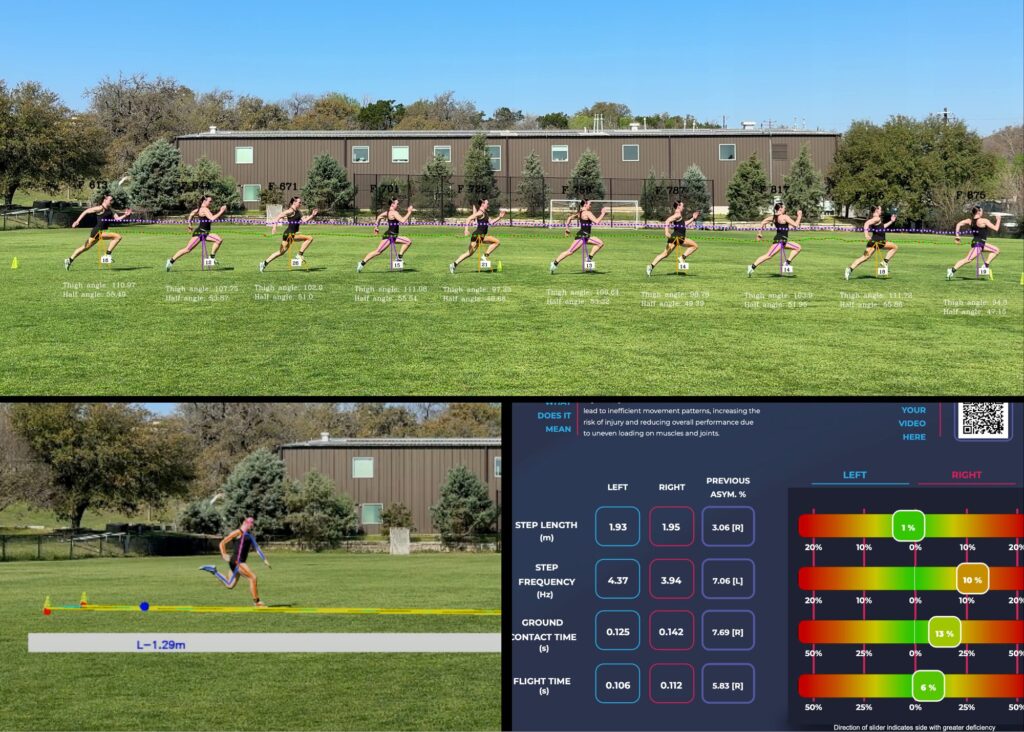
American football, and plenty of other sports, are built on explosive power from a standstill. Beating your opponent off the line, closing a gap, exploding out of a cut; these are decided in the first metre, not the twentieth. The early steps of a sprint are a distinct skill with their own mechanics.1,2
A single time can’t tell you why
A 20-metre time tells you how fast but it can’t tell you where. Two athletes can post the same time, one who explodes early and coasts, another who starts slowly and runs them down late. Knowing the velocity at each early step tells us which athlete we’re coaching, and exactly what to work on to make them quicker.3
The bigger picture
The Vuemotion reporting dashboard is next level. Instead of one figure on a stopwatch, the athlete sees how their speed builds step by step, and gets suggestions on what to improve next. That’s the sort of detail that used to live only in a biomechanics lab.
The one key takeaway: if your child plays a stop-start, explosive sport, first-step quickness is the trainable quality that will show up on game day and it’s worth measuring properly.
Written by,
Stewart Briggs, BHMS, M.Ed., C.S.C.S., RSCC*E
Managing Director of Acceleration Australia
References
1. Murphy, A.J., Lockie, R.G., & Coutts, A.J. (2003). Kinematic determinants of early acceleration in field sport athletes. Journal of Sports Science and Medicine, 2(4), 144–150. https://www.jssm.org/volume02/iss4/cap/jssm-02-144.pdf
2. Nagahara, R., Matsubayashi, T., Matsuo, A., & Zushi, K. (2014). Kinematics of transition during human accelerated sprinting. Biology Open, 3(8), 689–699. https://doi.org/10.1242/bio.20148284
3. Kawamori, N., Nosaka, K., & Newton, R.U. (2013). Relationships between ground reaction impulse and sprint acceleration performance in team sport athletes. Journal of Strength and Conditioning Research, 27(3), 568–573. https://doi.org/10.1519/JSC.0b013e318257805a
