

Left Side, Right Side: Why Asymmetry Is the Number NRL Players Should Watch
Rugby league is a brutal, one-side of the body game at times — favoured shoulders, favoured step, big collisions and heavy workloads that can quietly leave an athlete lopsided. The problem is that most testing never looks at the two sides of the body separately, so you never see it coming.
Vuemotion does. Every measure in the report has a left and right comparison running all the way through, and after two years using it at Acceleration Australia, that single feature has become one of the most valuable things we show our players.
What asymmetry is telling you
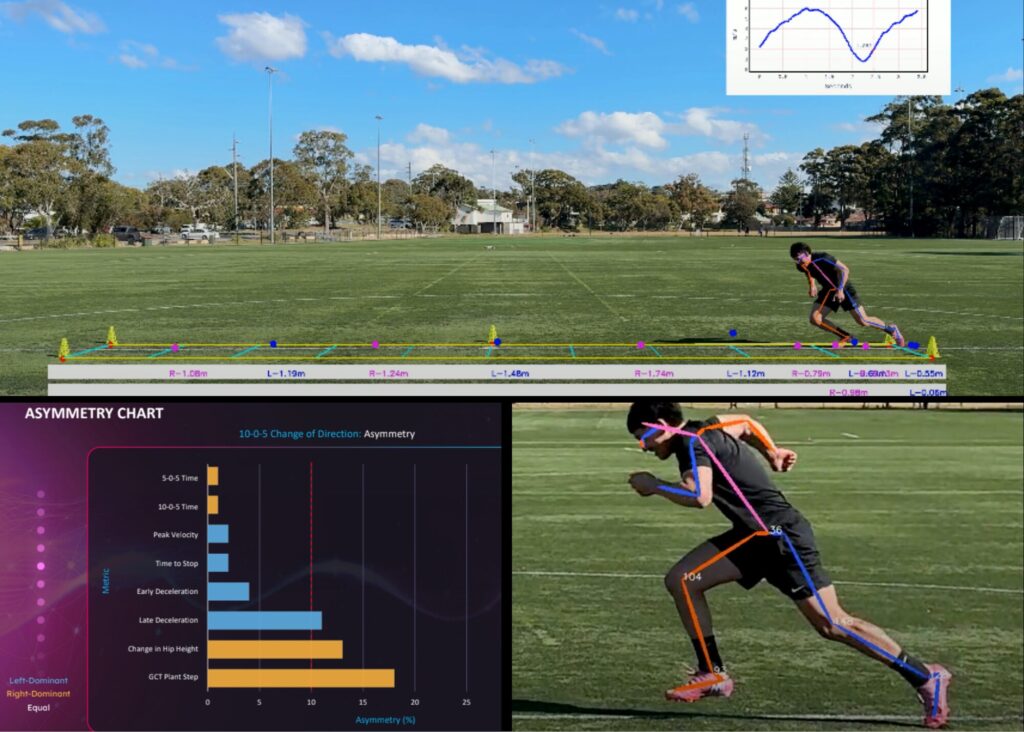
A meaningful gap between an athlete’s left and right side is worth knowing about. Imbalances in how each limb produces force have been linked to reduced performance, and can flag a body part, like a leg that’s doing less than its share.1 It doesn’t always mean something is wrong, but it’s exactly the kind of signal you want on your radar.3
A baseline that pays off after a knock
Capture a player’s left-right profile while they’re fit and you have a true baseline. After a hamstring injury or a heavy block of games, you can re-test and see whether they’ve returned to their own normal — rather than guessing. Tracking asymmetry over time is a sensible part of managing injury risk in collision athletes.2
3. Regular check-ins, not one-off tests
NRL players benefit most from regular check-ins. Having a quick re-test to make sure they haven’t drifted lopsided after big hits or heavy workloads is key. Little tests and often beats one test a year for catching and fixing problems as they come along. Obviously, catching any way ward movement over time and fixing them will benefit the player, their health and fitness for long-term play.
The bigger picture
Being able to see both sides of the body, on every measure, out on the training field rather than in a lab, is something we simply couldn’t do before this technology existed. It makes balance a thing you can actually manage instead of hope for.
The one key takeaway: for a contact-sport athlete, staying even side-to-side is one of the smartest, simplest ways to stay healthy and injury free.
Written by,
Stewart Briggs, BHMS, M.Ed., C.S.C.S., RSCC*E
Managing Director of Acceleration Australia
References
1. Bishop, C., Turner, A., & Read, P. (2018). Effects of inter-limb asymmetries on physical and sports performance: A systematic review. Journal of Sports Sciences, 36(10), 1135–1144. https://doi.org/10.1080/02640414.2017.1361894
2. Guan, Y., Bredin, S., Taunton, J., Jiang, Q., Wu, N., & Warburton, D. (2022). Association between inter-limb asymmetries in lower-limb functional performance and sport injury: A systematic review of prospective cohort studies. Journal of Clinical Medicine, 11(2), 360. https://doi.org/10.3390/jcm11020360
3. Dos’Santos, T., Thomas, C., & Jones, P.A. (2021). Assessing interlimb asymmetries: Are we heading in the right direction? Strength and Conditioning Journal, 43(3), 91–100. https://doi.org/10.1519/SSC.0000000000000590
