

Stride Length: A Simple Measure That Tells a Rugby Player How to Get Faster
In rugby union, every position needs speed — from a winger chasing a kick to a front-rower closing a gap. And one of the simplest, most honest windows into how a player runs is their stride length: how far they travel with each step.
It’s one of the measures we capture with Vuemotion, and I want to finish this series on the sport closest to home, with the point I care about most of all – this technology is Australian.
What stride length tells us
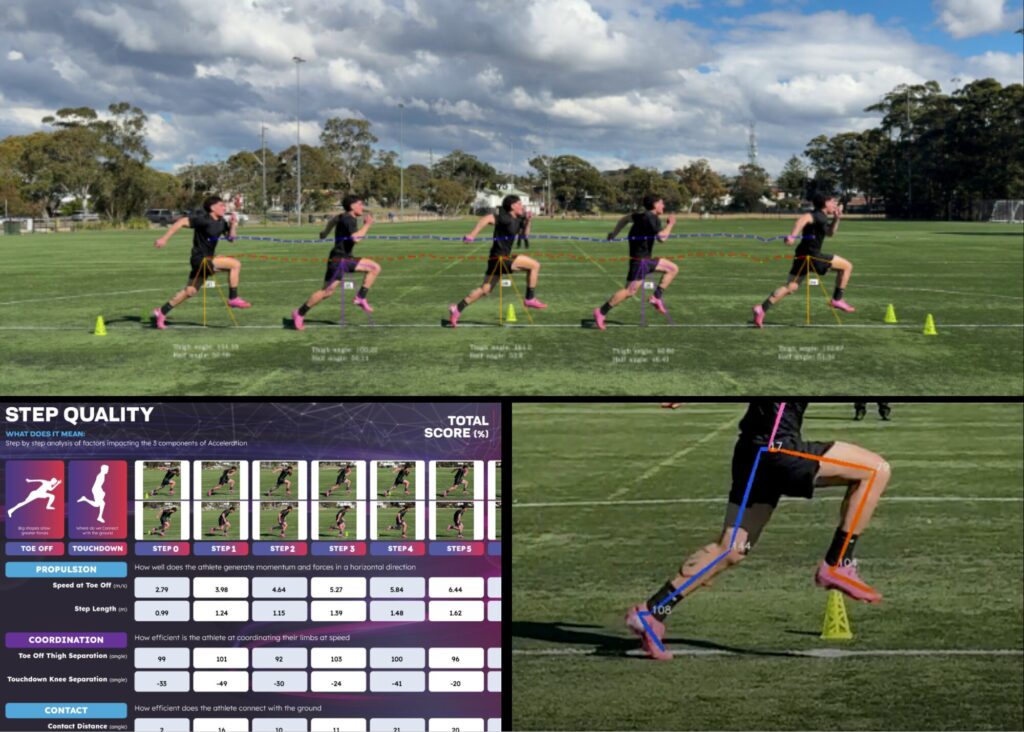
Sprint speed is the product of two things – how long each stride is and how often you take them.1 An instant, accurate measure of stride length gives us a clear starting point to educate the athlete about how they run and what will actually make them faster, whatever their position.
Checking whether the training is working
This is where the number earns its keep. When we do strength work or resisted sprint work, we want to know it’s translating to the field. Resisted-sprint and sled training are well known to improve acceleration and horizontal force production in rugby players2,3 and having clean sprint measures on either side of a training block lets us confirm the work is paying off rather than assume it.
(A note for accuracy: the strongest evidence links resisted sprint work to better acceleration and force into the ground rather than directly to longer strides. So, we treat stride length as a window into mechanics, not a promise a sled will lengthen it.)
The bigger picture
The part I love most is that Vuemotion is Australian, and you can test from almost anywhere. As long as you have an iPad or iPhone that meets the camera specifications and you follow the testing instructions, you can get accurate results in Alice Springs, Perth, Bendigo, Townsville — or in the middle of the bush, where plenty of our best young athletes are right now.
I’ve always been passionate about decentralising sports training and testing, so that talent isn’t held back by a postcode. Vuemotion goes a long way to making that vision a reality. We have built our very own training software with AccelerWare and now we have a way to also test athletes from anywhere with Vuemotion.
The one key takeaway: getting faster starts with understanding how you run — and now any rugby player, anywhere in the country, can find out.
Written by,
Stewart Briggs, BHMS, M.Ed., C.S.C.S., RSCC*E
Managing Director of Acceleration Australia
References
1. Hunter, J.P., Marshall, R.N., & McNair, P.J. (2004). Interaction of step length and step rate during sprint running. Medicine & Science in Sports & Exercise, 36(2), 261–271. https://doi.org/10.1249/01.MSS.0000113664.15777.53
2. Harrison, A.J., & Bourke, G. (2009). The effect of resisted sprint training on speed and strength performance in male rugby players. Journal of Strength and Conditioning Research, 23(1), 275–283. https://doi.org/10.1519/JSC.0b013e318196b81f
3. Morin, J.B., Gimenez, P., Edouard, P., Arnal, P., Jiménez-Reyes, P., Samozino, P., Brughelli, M., & Mendiguchia, J. (2015). Sprint acceleration mechanics: The major role of hamstrings in horizontal force production. Frontiers in Physiology, 6, 404. https://doi.org/10.3389/fphys.2015.00404
