

Switching in the Air: The Sprint Mechanic That Helps AFL Players Break Clear
The best moments in AFL often come from one thing: a player bursting clear of the pack to get a kick away. That ability to break into space is built on good sprint mechanics and one of the clearest markers of good mechanics is how the legs “switch” in the air.
At Acceleration Australia we measure this with Vuemotion. We’ve using Vuemotion’s AI movement system for two years and are proud to be using it to help Aussie Rules players have the explosive speed they need.
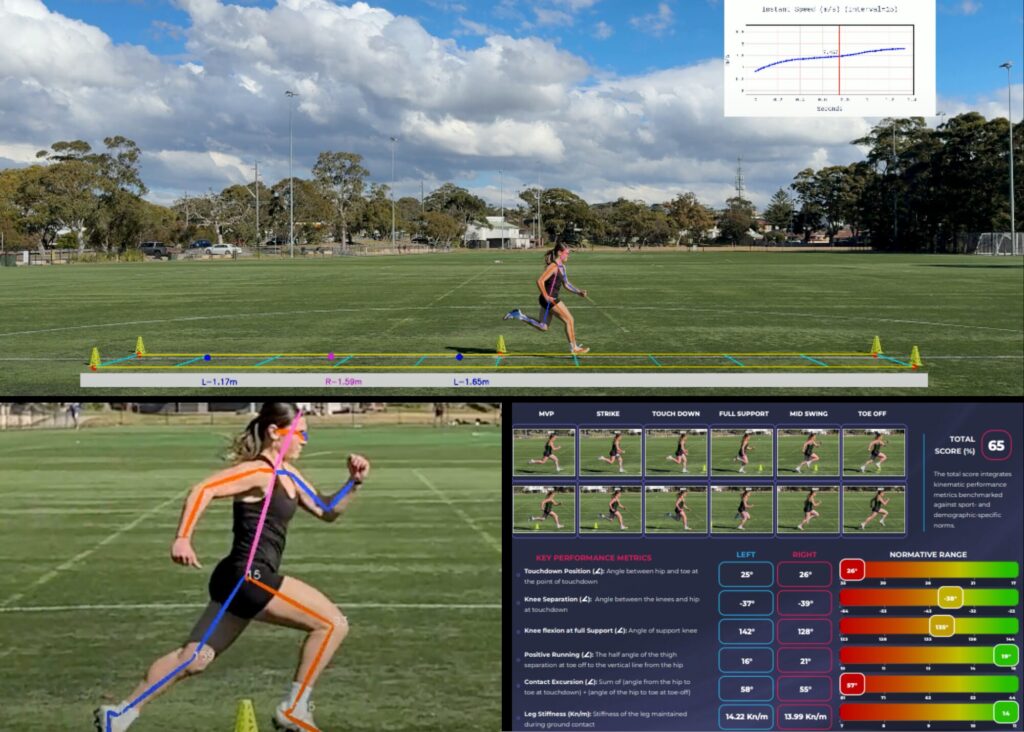
What “switching” means
As one leg drives back into the ground, the other should be recovering forward — the two thighs passing each other cleanly. The distance between the thighs at touchdown tells us whether the legs are switching through the air quickly and cleanly enough, which is a hallmark of efficient sprinting.3
Turnover and true speed
Speed comes from a balance of two things: how much force you put into the ground, and how quickly you can reset for the next step. Elite speed is ultimately built on applying big forces in a short contact1, and clean switching mechanics are what let an athlete cycle the legs efficiently to do it, step after step.2
Around the ruck and stoppages, where a metre of clear space wins the ball, that ability to switch and burst is what makes the difference on the day.
The bigger picture
Here’s what excites me the most. Proper 3D lab testing could always measure this sort of thing, but it isn’t consumable — you can’t run a whole squad through a biomechanics lab. Vuemotion gives us measures that were never available in the field before, at an acceptable cost, with an interface a coach can actually use.
The one key takeaway: speed on the field isn’t only about being “fit” — it’s about how well the legs move. And now that we can measure it, we can coach it.
Written by,
Stewart Briggs, BHMS, M.Ed., C.S.C.S., RSCC*E
Managing Director of Acceleration Australia
References
1. Weyand, P.G., Sternlight, D.B., Bellizzi, M.J., & Wright, S. (2000). Faster top running speeds are achieved with greater ground forces not more rapid leg movements. Journal of Applied Physiology, 89(5), 1991–1999. https://doi.org/10.1152/jappl.2000.89.5.1991
2. Hunter, J.P., Marshall, R.N., & McNair, P.J. (2004). Interaction of step length and step rate during sprint running. Medicine & Science in Sports & Exercise, 36(2), 261–271. https://doi.org/10.1249/01.MSS.0000113664.15777.53
3. Miyashiro, K., Nagahara, R., Yamamoto, K., & Nishijima, T. (2019). Kinematics of maximal speed sprinting with different running speed, leg length, and step characteristics. Frontiers in Sports and Active Living, 1, 37. https://doi.org/10.3389/fspor.2019.00037