

What Do Major League Baseball Teams Use to Measure How Their Players Move? Vuemotion
Baseball has a special place in my heart because it was the first championship ring I received back in 1998 and it was a sport that I brought speed training to with great affect. So if 1998 sounds like a long time ago, it should. I have been doing this stuff for a long time and know my apples when it comes to speed training baseball players.
Ask a room full of parents what wins a close play at first base and you’ll hear “bat speed” or “good eye”. The truth is simpler: getting down the line before the ball does. Speed to first base is decided almost entirely by pure acceleration — how quickly a player builds velocity over the first few steps out of the box rather than by top-end speed they never reach in ninety feet.1
So what do some Major League Baseball teams use to actually measure how their players move? Vuemotion. It’s an Australian AI invention, and it has changed the way we look at athlete movement. At Acceleration Australia we’ve used it for two years, and we’re heading into our third. It has become one of the most valuable tools in our kit.
Getting to first base is a sprint, not a jog
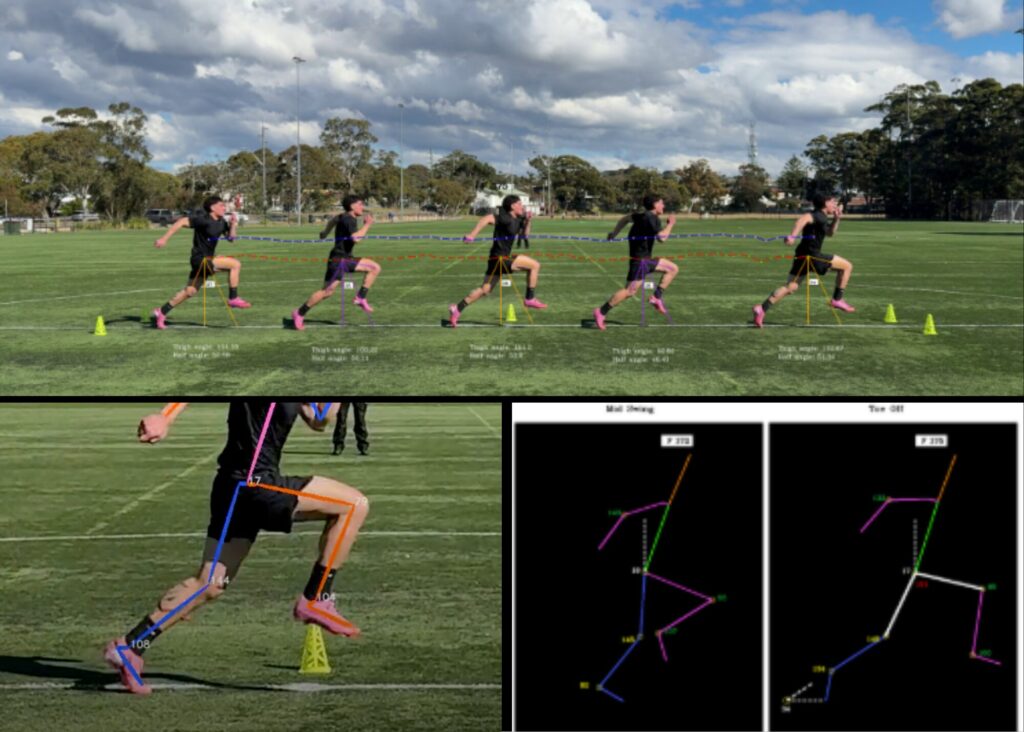
Beating a throw to first is a short, explosive sprint in a straight line. The window is tiny, so every hundredth of a second in the first few steps matters. That’s why we assess players doing exactly what the game asks of them — sprinting.
“Contact Distance” — a measure we simply couldn’t get before
One of the many measures Vuemotion gives us is called Contact Distance: how far the hips travel through space while the foot is in contact with the ground. It’s a window into how well a player is pushing the ground behind them and carrying their body forward on each step. This is exactly what early acceleration is built on.2,3
Never before have we been able to capture a number like this out in the field. This is real athlete assessment — the player performing an actual baseball action, sprinting flat out, while we measure how their body is moving.
The bigger picture
The exciting part is that Vuemotion measures aspects of human movement that were never possible to capture in the field before. Proper 3D lab testing has always existed, but it isn’t something you can put a whole squad through week to week. Now we can — and we can hand the athlete something concrete to work on.
If your son or daughter plays baseball and you want them a step quicker down the line, the one key takeaway is this: train the first few steps, and measure them properly. That’s where the play at first is won or lost.
Written by,
Stewart Briggs, BHMS, M.Ed., C.S.C.S., RSCC*E
Managing Director of Acceleration Australia
References
1. Coleman, A.E., & Amonette, W.E. (2012). Pure acceleration is the primary determinant of speed to first-base in major-league baseball game situations. Journal of Strength and Conditioning Research, 26(6), 1455–1460. https://pubmed.ncbi.nlm.nih.gov/22450255/
2. Kawamori, N., Nosaka, K., & Newton, R.U. (2013). Relationships between ground reaction impulse and sprint acceleration performance in team sport athletes. Journal of Strength and Conditioning Research, 27(3), 568–573. https://doi.org/10.1519/JSC.0b013e318257805a
3. Hunter, J.P., Marshall, R.N., & McNair, P.J. (2005). Relationships between ground reaction force impulse and kinematics of sprint-running acceleration. Journal of Applied Biomechanics, 21(1), 31–43. https://doi.org/10.1123/jab.21.1.31
