

Why Leg Stiffness Is a Basketballer’s Secret Weapon
How We Measure It
At Acceleration we train more basketball athletes than any other sport at the time of writing this article. Our knowledge and experience with working at all levels of the game only gets better over time, so we are always on the lookout for what will help us take our training to another level.
Watch a good guard for a minute and you’ll notice most of the game happens in tiny movements — a jab step, a quick cut, a gather into a jump, a scramble on defence. Basketball rewards the athlete who can produce and absorb force fast, again and again, in a very small space.
The quality behind that is leg stiffness, and it’s one of the things we measure at Acceleration Australia using Vuemotion, the Australian AI movement system we’ve worked with for two years and counting.
What “stiffness” really means
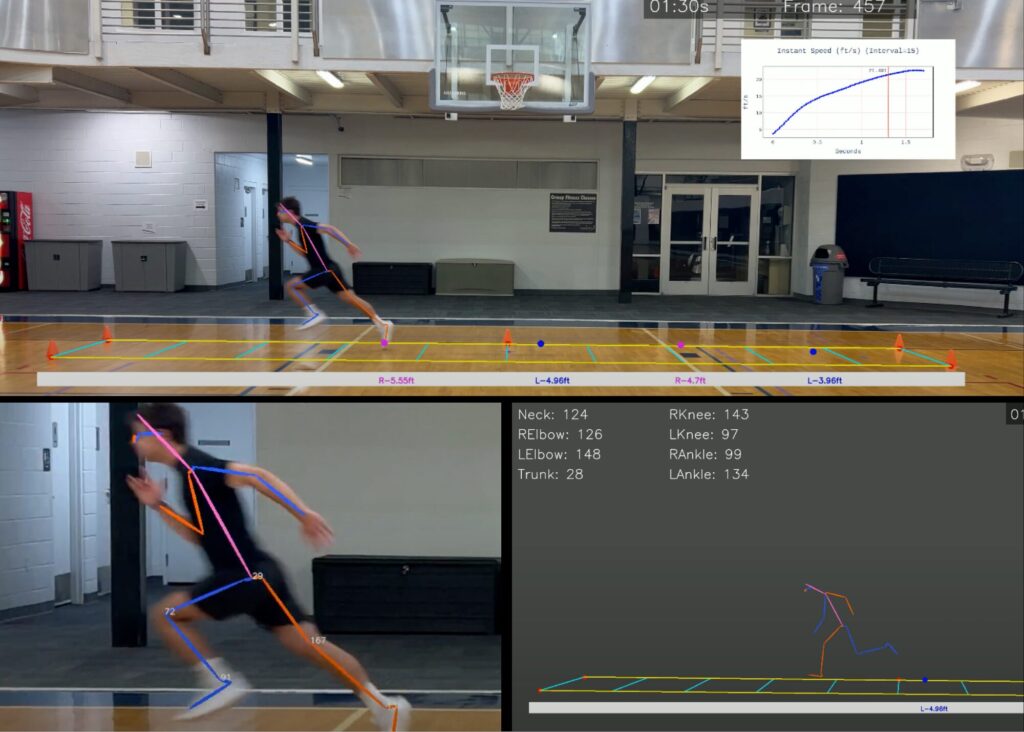
Stiffness sounds like a bad thing, but here it’s a compliment. A stiff, springy leg spends less time on the ground and returns more energy on each contact — like a firm basketball versus a flat one. It’s a key ingredient in fast ground contacts, quick change of direction and jumping.1
Quick feet come from the ground up
The best way to think about it is contact time. The less time a springy leg spends absorbing and re-applying force, the quicker the next movement can start — which is why reactive strength is such a useful window into fast stretch-shortening ability.2 On a court, that’s the difference between arriving a fraction early and a fraction late.3
The bigger picture
None of this used to be easy to see in the field — you needed a lab. Now we can measure it inside the Vuemotion app, on an iPad, with a genuinely usable interface that puts the result and a plan in front of the athlete straight away. That’s a big shift for a young player who just wants to know what to work on next.
The one key takeaway for parents: quick feet aren’t just “natural talent”. Stiffness is a trainable quality — and once you can measure it, you can build it.
Written by,
Stewart Briggs, BHMS, M.Ed., C.S.C.S., RSCC*E
Managing Director of Acceleration Australia
References
1. Brazier, J., Maloney, S., Bishop, C., Read, P.J., & Turner, A.N. (2019). Lower extremity stiffness: Considerations for testing, performance enhancement, and injury risk. Journal of Strength and Conditioning Research, 33(4), 1156–1166. https://pubmed.ncbi.nlm.nih.gov/29112054/
2. Flanagan, E.P., & Comyns, T.M. (2008). The use of contact time and the reactive strength index to optimize fast stretch-shortening cycle training. Strength and Conditioning Journal, 30(5), 32–38. https://doi.org/10.1519/SSC.0b013e318187e25b
3. Barrera-Domínguez, F.J., et al. (2024). Strength characteristics in faster change of direction basketball players: A comparison across cutting angles. European Journal of Sport Science, 24(8). https://doi.org/10.1002/ejsc.12164